Restaking Protocols
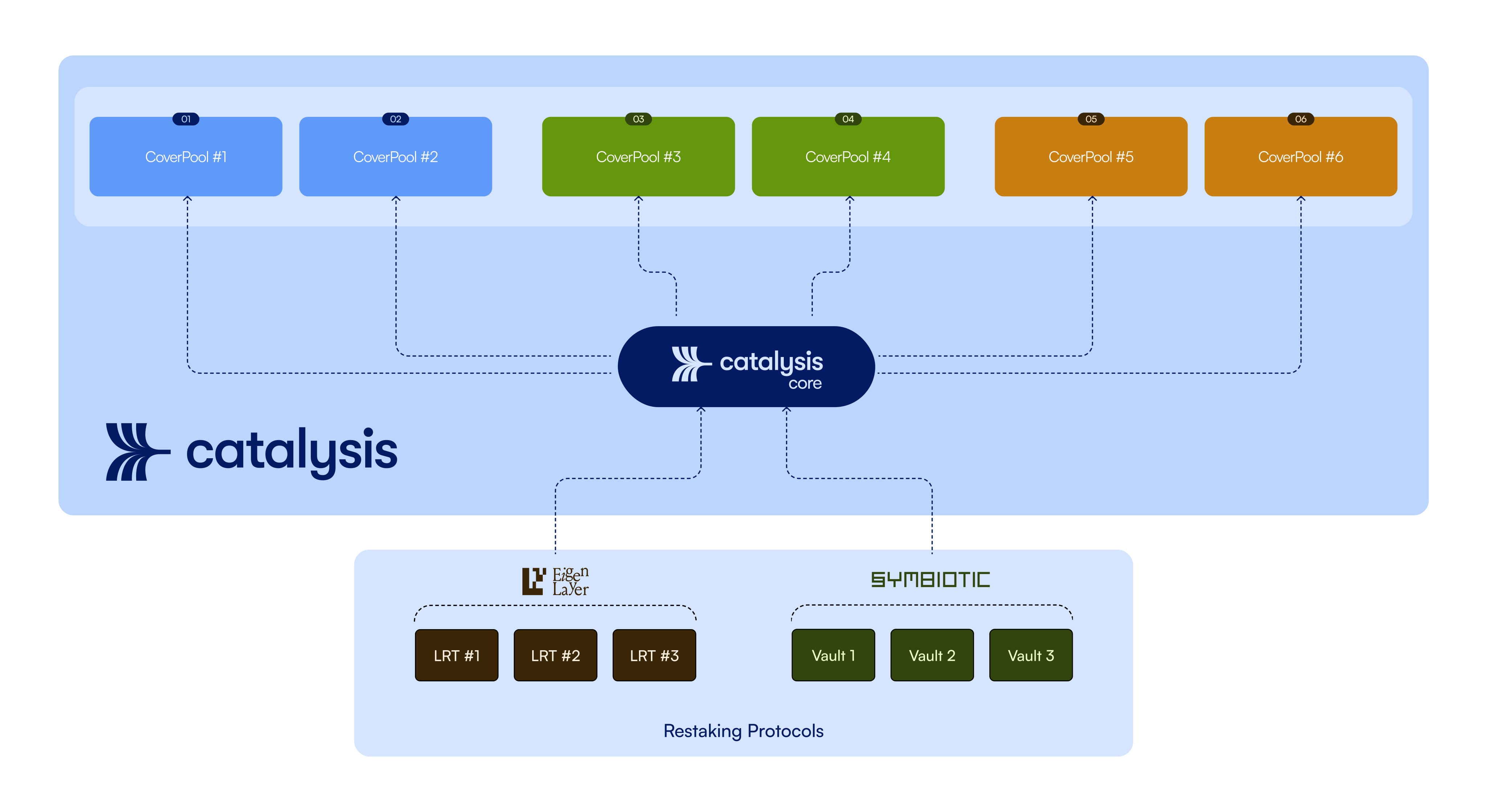
Restaking protocols are the infrastructure layer that custodies and tracks restaked collateral and provides the enforcement rails (rewards + slashing) that underwriting capacity is built on.
They act as the coordination layer between delegators and Catalysis:
- They custody restaked assets and expose verifiable accounting of who has delegated what.
- They enforce protocol-defined rules for reward distribution and slashing, which Catalysis can use as enforcement primitives for underwriting.
- They provide the delegation primitives that let capital be allocated toward different underwriting configurations (e.g., CoverPools).
Visualization
FAQs
Q1. Which restaking protocols does Catalysis support today?
Currently: EigenLayer and Symbiotic (both on Ethereum Mainnet).
Support is implemented via protocol-specific integrations and can expand to additional restaking and liquidity layers over time.
Q2. Does the restaking protocol take a cut of rewards?
It depends on the restaking layer (and sometimes the LRT / curator you use). Some protocols apply protocol-defined fees or reward splits on AVS reward flows (e.g: EigenLayer charges 20% fees).
Catalysis does not control these fees — partners should refer to the restaking protocol’s latest fee model.
Q3. Can delegators choose any supported restaking protocol?
Yes. Delegators can restake via any supported restaking layer.
Catalysis is designed to utilize underwriting capacity across multiple restaking protocols in parallel (capacity remains accounted for within each underlying restaking layer).
Q4. Can Catalysis coverage work without a restaking layer?
In principle, YES. But it would require rebuilding the same primitives from scratch (collateral accounting, delegation, rewards distribution and slashing guarantees).
Using established restaking protocols allows Catalysis to leverage hardened infrastructure and existing liquidity, which significantly accelerates go-to-market.
FAQs - Caps, Duration & Incentives
Q1: What exactly are delegation caps?
Delegation Caps represent phased increases in underwriting capacity. Each cap introduces one or more new duration-based vaults, each with a defined size, duration and incentive structure.
The Catalysis roadmap currently has three caps spanning Q1 to Q3 2026.
Q2: Do early restakers earn meaningfully higher returns?
YES. Delegators participating in early caps benefit from higher incentives, resulting in meaningfully higher risk-adjusted returns.
Q3: Is the cap per vault, per CoverPool or global?
No, Caps are not per vault or per Coverpool. Each cap generally supports multiple vaults or coverpools depending on the coverage demand and business requirements.
Q4: Can caps be increased mid-duration?
NO. Once a cap is filled, capital is locked for the full duration of that vault. New capacity is added only via a new cap.
Q5: Who decides when a new cap is opened?
The Catalysis Core team decides the terms and conditions of opening up a new cap. Each new cap increases the overall coverage limit and is opened based on demand, risk appetite and operational readiness.
Q6: Can I delegate to multiple caps at the same time?
NO. Each cap corresponds to a separate duration-based vault. Capital must be withdrawn from one vault before redeploying into another.
Q7: If I've delegated to Cap 1, what happens when the duration ends?
Withdrawals open at maturity. You can withdraw your capital or redeploy it into new vaults in the subsequent caps with updated parameters and incentives.
Q8: How long do incentives last within a single cap?
Incentives for each cap are designed to last approximately one full calendar year.
Q9: What incentives apply in each cap?
Each cap may have different restaking and protocol incentives ($EIGEN, $CAT). As a result, the risk-reward profile and APR vary across caps.