Delegators
Delegators supply the capital that backs Catalysis CoverPools. In return, they earn coverage fees (premiums) while taking on well-defined loss risks.
They are the capacity providers of the system:
- Their capital is the source of underwriting capacity.
- CoverPools use that capacity to offer protection to Covered Vaults.
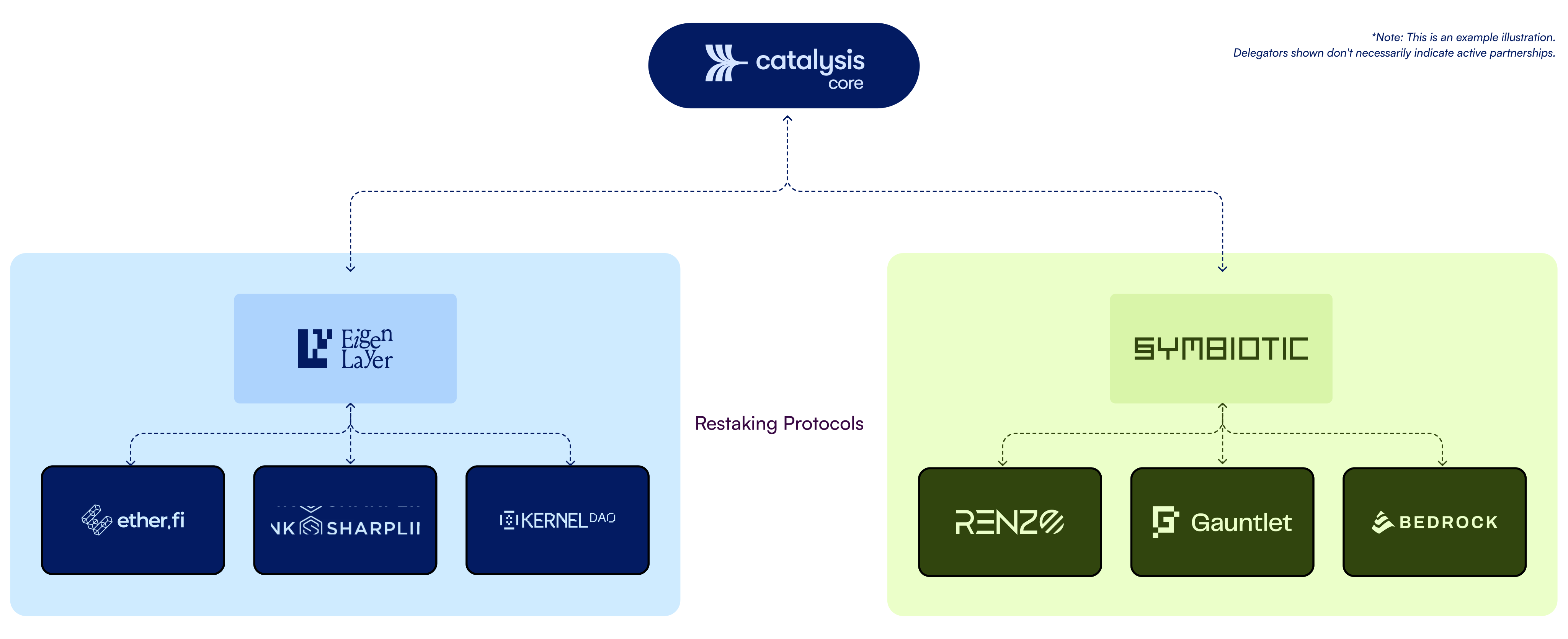
Visualization
Risk Design
Catalysis is designed to minimize tail risk for restakers through strict vault selection, disciplined underwriting and capped downside exposure.
- Tier-1 DeFi vault eligibility: Coverage is intentionally limited to ONLY A-rated vaults curated by Gauntlet and Steakhouse Financial on Tier-1 protocols such as Morpho.
- Quantitative underwriting: Vault eligibility and pricing are informed by our robust underwriting engine across curator quality, protocol risk and asset profile.
- Capped loss scenarios: Historical data indicates a <1% chance of a qualifying vault triggering the maximum payout (e.g., 10% of TVL).
How Delegators Earn
Delegators generally earn a blend of:
- Coverage fees (Base APY): Premiums paid by Covered Vault participants
- Native Staking Rewards (Optional): Native ETH staking APY for ETH LSTs (say $wsETH)
- Restaking Rewards: Incentives from the underlying restaking layer (say $EIGEN)
- Catalysis Incentives: Protocol incentives (wherever applicable)
FAQs
Q1. Is Catalysis legally “insurance”?
NO. Catalysis is not an insurer and does not provide insurance or reinsurance services.
Catalysis provides native onchain risk coverage infrastructure, where:
- Terms are transparent and programmatic
- Capital providers knowingly take on defined risk
- Payouts follow pre-specified smart-contract based rules
For more details, please visit our T&Cs page.
Q2. Can delegators lose principal?
YES. If a covered trigger occurs, the CoverPool pays out according to its terms. Those payouts can reduce the capital backing the pool (and therefore delegator principal).
Q3. What drives my realized returns over time?
Returns generally depend on:
- CoverPool utilization: How much capacity is actively underwriting
- Premium rates: Risk-calibrated pricing
- Claims frequency: How often payout events trigger (highly unlikely)
Q4. Can I withdraw or reallocate?
Typically, capital allocated to a CoverPool is locked for a fixed duration (typically ~90 days).
Depending on the configuration, Catalysis can support Early withdrawals (with constraints) or Withdrawal restrictions while capacity is actively underwriting.
Q5. What types of risks are covered by Catalysis CoverPools?
Coverage is vault-level and risk-specific, not protocol-wide.
Depending on the vault configuration, covered risks may include:
- Curator Risk – mispricing, parameter misconfiguration, or strategy failure.
- Asset-Level Risk – sudden de-peg, extreme volatility, or collateral impairment.
- Bad-Debt Risk – borrower default, oracle error, or collateral shortfall.
- Smart Contract Risk – vulnerability in vault, Morpho, or token contracts.
Each CoverPool explicitly defines what is covered and what is excluded. Delegators should always review the coverpool’s risk specification before allocating.
Q6. What should I evaluate before allocating to a CoverPool?
Focus on the pool’s risk boundary and economics:
- What events are covered (and explicitly not covered)
- Payout limits / maximum loss and how payouts execute
- Premium rate assumptions and expected utilization
- Any timing constraints (allocation windows, withdrawal rules, cooldowns)
Q7. How are payouts calculated if a loss event occurs?
Payouts are proportional to the loss amount, not binary.
- Losses are assessed per depositor, based on changes in the vault’s price per share between deposit and withdrawal. If the price per share at withdrawal is lower than at deposit, the difference is treated as a qualifying loss.
- Example: If a depositor enters when 1 share = $1.00 and exits when 1 share = $0.90, the $0.10 difference represents a loss eligible for coverage.
For example, for A-rated Morpho vaults, the maximum payout may be capped at up to 10% of vault TVL, with historical data indicating a very low probability (<1%) of reaching that cap.
Q8. Are losses isolated between different CoverPools?
YES. All CoverPools are fully isolated:
- Each DeFi vault is paired with its own CoverPool
- Losses in one coverpool do not affect other pools (isolated)
- There is no shared global pool (we don’t normalize losses)
This modular isolation model is intentional and designed to limit contagion risk.
Q9. Who decides which vaults are eligible for coverage?
Vault eligibility is strictly controlled. This is currently decided by the Catalysis Core team. As we progressively decentralize the protocol, it will be decided by future governance proposals.
Eligibility is determined using:
- Internal quantitative underwriting models
- Curator quality and track record
- Protocol risk, asset profile, and historical behavior
Lower-tier or experimental vaults are intentionally excluded during the initial launch phase. Currently, coverage is limited to only A-rated vaults curated by Steakhouse Financial and Gauntlet on Tier-1 DeFi protocols (e.g., Morpho)
Q10. How is risk monitored over time?
Risk monitoring is continuous.
- Underwriting models are updated with live vault and protocol data
- External risk signals and ratings are sourced from Credora (via RedStone)
- Real-time security monitoring is supported by partners such as Hypernative
If risk conditions deteriorate materially, new coverage issuance can be paused or repriced.
Q11. Is claims resolution fully automated?
Claims resolution is FULLY AUTOMATED in the current phase:
- Determined by pre-defined smart contract logic
- Triggers are programmatically detectable and onchain
- There is currently no discretionary governance veto over valid claims
- Some edge cases may rely on oracle inputs or offchain verification
The system is designed to move toward a hybrid resolution as coverage limits scale and governance is in place.
Q12. What assets do delegators earn rewards in?
Delegators earn in the same collateral/asset type as the underwriting capital they are delegating.
Depending on the CoverPool:
- Coverage premiums (often in the vault’s base asset or stablecoins)
- Restaking rewards from the underlying restaking layer (e.g., EigenLayer)
- Catalysis protocol incentives, where applicable
Currently, we don’t support transfers like USDC to ETH since we want to ensure asset liability matching. But, rewards can be in $WETH for $wstETH underwriting capital (same base asset conversion). We’ll support more kinds of reward tokens (say $USDC, $USDT) in the future.
Q13. Can I choose different risk-reward profiles?
YES. Catalysis supports multiple CoverPools with different characteristics:
- Lower-risk pools backing top-tier vaults with conservative payout caps
- Higher-yield pools with higher utilization or broader coverage scope
Delegators can allocate capital across Coverpools based on their risk appetite.
Q14. How long is my capital locked?
CoverPools typically operate with fixed allocation periods, commonly around 90 days. But it depends on the specific configuration of CoverPools and the risk reward metrics.
Q15. What is the current stage of the protocol?
Catalysis is currently in a controlled mainnet rollout phase. It is launching on Ethereum mainnet in late Q1 2026.
For this launch, coverage is limited to top-tier vaults, risk parameters are conservative and scale is intentionally capped. This approach prioritizes correctness and confidence before expanding to other DeFi vaults / protocols.
Q16. Why should restakers participate early?
Early participation allows restakers to:
- Back one of the first revenue-generating AVSs supported by real economic activity
- Earn premium-driven yield while underwriting the next wave of DeFi adoption
- Gain exposure to high-quality Covered Vaults with disciplined underwriting
- Earn early catalysis protocol incentives (where applicable)
Catalysis is a first-of-its-kind AVS bringing vault-native risk coverage onto restaking rails. This is not incremental — it’s a step-function unlock.
Q17. Do you rehypothecate restaker capital?
NO.
At the current stage, capital allocated to a CoverPool is not rehypothecated or reused elsewhere. It’s used 1:1. Capital is only used as underwriting capacity for the specific risks defined by that coverpool.
We intentionally avoid rehypothecation today because it introduces additional layers of correlation and tail risk, which is not appropriate during an early, controlled rollout.
In the future, we may explore underwriting fully uncorrelated markets (e.g., RWAs or real-world insurance risks) — but only once the system has matured and risk isolation can be preserved.
Q18. Is there real demand for onchain coverage at scale?
YES. ABSOLUTELY.
- As DeFi and stablecoins go mainstream, major crypto and fintech platforms are launching structured earn products at scale, signaling sustained demand for risk-managed yield.
- Products like Coinbase Earn and Kraken’s vaults with Veda show that users (retail and institutional) want yield that is risk-adjusted, not just higher APY.
- Institutional allocators cannot deploy meaningful size without clear downside protection, a behavior long established in TradFi where lower yield is accepted in exchange for risk mitigation.
- Existing coverage markets already indicate $50M–$100M of coverage demand per Tier-1 protocol like Morpho, revealing a clear supply gap that covered vaults can unlock natively and efficiently.
Q19. When does my delegation start earning premiums?
Day 1.
- Premium APR is dynamic and determined by supply/demand: coverage demand vs available underwriting capacity.
- Premiums typically scale as Covered Vault TVL grows and CoverPool utilization increases.
- In parallel, restakers may continue earning restaking-layer rewards (e.g., EigenLayer) and Catalysis incentives (where applicable).
Q20. When does slashing activate?
Day 1. Once your capital is locked for the specified duration, it becomes slashable under the pool’s pre-defined coverage conditions.
Q21: What happens if Catalysis contracts have a bug?
Catalysis contracts are audited by Tier-1 auditors including ChainSecurity, Sigma Prime and Failsafe.
That said, smart contract risk is never zero — even Aave is not immune. This is why we’re launching coverage conservatively and scaling it gradually.
Q22: Is the coverage non-custodial? Do you ever take custody of funds?
NO.
Catalysis never takes custody of funds. Underwriting capital remains custodied in the underlying restaking layer (e.g., EigenLayer) and is referenced by Catalysis contracts for underwriting and enforcement logic. Premium and payout flows are executed onchain into the underlying DeFi vault protocol (e.g., Morpho) according to protocol-defined rules.
Q23: Is this correlated with EigenLayer slashing risk?
NO.
IT HAS ZERO CORRELATION WITH AVS SLASHING RISKS. Coverage risk is separate from EigenLayer AVS slashing. Losses only occur from economic underwriting events, not validator misbehavior or uptime faults.
Catalysis does not rehypothecate stake, underwriting capital is used on a strict 1:1 basis and remains uniquely allocated.
Q24: How is this different from Nexus Mutual?
| Dimension | Catalysis Coverage | Nexus Mutual |
|---|---|---|
| Product | Vault-native risk coverage infrastructure | Discretionary onchain insurance mutual |
| Coverage UX | Embedded natively inside DeFi vaults as a first-class primitive | External cover purchased separately as a standalone product |
| Underwriting | Transparent, smart contract based model using onchain data with Credora risk ratings; no discretionary underwriting | Discretionary underwriting by members; opaque capital allocation and offchain claim assessment |
| Pricing | Risk-aware, vault-level pricing driven by Catalysis underwriting engine; typically 4–5× cheaper for Tier-1 and A/B-rated vaults | Utilization-based pricing with discretionary parameters; often materially more expensive for comparable risk |
| Settlement | Programmable, onchain settlement; DeFi vault-native infrastructure built to scale with institutional vault distribution | Manual claims process, slower settlement; legacy insurance logic not designed as vault infrastructure |